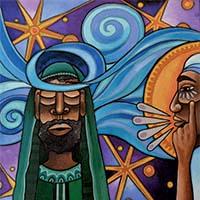
Alleluia, Christ has risen!
Image attribution: JESUS MAFA. Easter - Christ appears to Mary, from Art in the Christian Tradition, a project of the Vanderbilt Divinity Library, Nashville, TN. https://diglib.library.
Saturday, April 8, 2023
Easter is Lurking
Monday, March 20, 2023
Up from the grave... John 11
John 11 is a familiar story. We hear it a lot at funerals. Lazarus, Jesus’ friend has died unexpectedly and Jesus – perhaps fearing for his own life delays in traveling to Bethany for the funeral. When he does finally arrive, Martha and then Mary come to meet him and all of those people who were there to console the sisters came with them. Jesus was their teacher, their rabbi, their friend. He was the one who they expected would make sense of all of this horrible grief that consumed them.
Martha’s
grief turns to rage and she accuses Jesus of being uncaring. Jesus, in what is for me one of the most
poignant revelations of God’s nature, is overcome by grief himself and begins
to weep. But he doesn’t make excuses for his tardiness. Instead he
turns the conversation into one that is grounded in faith. He reassures
Martha that in fact death is not the ultimate outcome of life and he gently and
lovingly recalls the mystery of his relationship with God and the hope for
salvation that comes from that mystery. And then he instructs the crowd
to roll away the stone. Once again Martha chides him. “But Lord it
has been 4 days – there will be a stench.” Jesus insists and then with
the authority of one who knows that with God there is always the opportunity
for renewal - he calls Lazarus forth out of the tomb.
It is short-sighted to see this as just a story about Lazarus coming back to life. Salvation is about transformation in this life. Transformation of self and more expansively transformation of a very broken world in this life – not salvation as preparation for the next. This lesson invites us to imagine the possibility of resurrected lives all around us – in ourselves, our families, our community and the world. Resurrection for those who desperately need it right now.
William Barclay, a 20th
century theologian from Scotland said that the miracle stories of the Bible are
symbols of what God can do today. He was severely criticized for his
expansive understanding, but it certainly resonates with me. How we live into these stories of God’s
action in our world will determine whether or not the church becomes a 21st
century prophetic voice or whether it becomes tired and obsolete and simply
fades away into oblivion. We cannot sit
back and wish that young people appreciated the music and liturgy that molded
our childhood. We who believe that with
God all things are possible, including new life from dead and buried souls,
must affirm our beliefs with our actions.
Today John invites us to stand at the tomb of Lazarus and to imagine a
possibility beyond the stench of a decaying body. To dream about the
possibilities for transformation of our lives and the lives of those around us
in unfettered and limitless dimensions. To listen for the voice of Jesus
calling us to come out of our blindness, our captivity, our lifelessness and to
experience the joy of a resurrected life.
Let us pray: Gracious and
loving God, give us ears to hear you when you call to us, eyes to imagine the
possibilities of a life lived in You, and the willingness to step up and unbind
those whom you awaken this day. Amen
Sunday, March 12, 2023
I was blind, but now I see... Amazing Grace
The story is ripe with
paradox. Things are just not as they
seem to be. A blind beggar who has the
audacity to instruct the church hierarchy in their own law, healed by a disappearing
Rabbi who likes to play in the mud, and on the Sabbath too. Shame! Shame! What is this world coming to? It seems that the restoration of this
beggar's sight reveals more than the landscape.
This enlightenment reveals the spiritual blindness of all of those
around him who are so caught up in their own manufactured world that they fail
to see God's light shining in Jesus.
Being able to
see requires that we disclaim all that we hold dear in order to claim life in
Christ. We must turn our backs on our own self-centered path and follow Jesus
into an unknown place where we are forgiven and where we are to be beloved of
God. It will be a relationship that is
kindled through healing, through forgiveness, and through restoration. Jesus tells us that things will come about
through God’s actions, not through our adherence to old worn-out
pre-conceptions or through our manipulation of events. God must be a facilitator if the relationship
is to be whole and those who want to be able to see clearly will need a change
of heart that allows us to respond appropriately and faithfully when God calls
us.
Mother Jane
Tuesday, March 7, 2023
Living Water - Troubled Water
John 4: 5-42
Our bodies are made up of about 60% or so of water. Without a doubt water is central to every aspect of our lives. So it is not surprising to me our scripture uses images of water to describe such things as faith, eternal life, safety, provision, even power.
This week we have the second of that series of stories from John that I mentioned on Sunday. Each one of them is laced with profound images: darkness and light, blindness and seeing, confinement and freedom, isolation and inclusion. John’s gospel is at its core a gospel of love, telling us through signs, stories, and witness of the profound and expansive love of God that is revealed to us in Jesus. And John uses the images of our everyday lives to describe that love. Daytime and nighttime, water, eyesight, wells, burial… these stories are poignant for us because we know them intimately. We live them everyday.
Jesus makes a profound statement to the Woman at the Well:
"If you knew the gift of God, and who it is that is saying to you, `Give me a drink,' you would have asked him, and he would have given you living water."
Living water…. Troubled water… Water through which God’s gift is given. The Living Water that Jesus gives transforms her life and in transforming her life, transforms the lives of others.
We should not open our mouths to drink of the Living Water unless we are ready to be transformed. This water that Jesus gives comes with a cross. It comes with the cross of foregoing our own wants and desires in order to provide dignity, respect, and love to those who are in need. It comes with the cross of pain and hurt of illness, poverty, or isolation. It comes with the cross of responsibility to envision God’s hope for the world and to work for that end. It comes with the cross of uncertainty that comes with living our lives with faith in God rather than in worldly power.
I’m good with that! Buen Camino,
Mother Jane
Oh Nichodemus!
|
Friday, September 10, 2021
A reflection offered at Sacred Heart Catholic Church in Cambridge Mass, Dec, 2001
On Monday Nov. 19, 2001, I boarded a bus in South Station for Manhattan. I traveled with fellow deacon, Daphne Noyes. We were responding to a call for help from deacons in New York, to serve as chaplain at the World Trade Center site. A site known as the HellHole, the Pit, the Pile, Ground Zero. We arrived early, met our contact person, Keith, and headed down Fulton Street to the temporary morgue that was set up just a few yards from what was left of the twin towers.
Once in the morgue we met those chaplains whom we were relieving. One was a Rabbi and one a Catholic Priest. We discussed the importance of offering prayers over the remains that would be appropriately ecumenical for civilian casualties. We chose to pray with the Psalms, the 121st and the 23rd. Then we were briefed on our duties. We were to wait until we got a call that one of the spotters had found remains. Then we were to go with the EMTs into the hole to pray with the laborers and fireman who were there. We would accompany the remains to the morgue where a medical examiner would determine, if in fact, there were human remains present and whether or not the remains were that of a person of service, a fireman or policeman. If so, the body bag would be draped with an American flag. We were to offer prayers for the deceased and for the men and women working there and an honor guard would stand watch while the flag draped litter was carried to an ambulance to be transported to the main morgue at Bellevue Hospital. - I have never prayed so hard in my life. I prayed for those who lost their lives. I prayed for the men and women who had survived. I prayed for those of us who felt distant and helpless in the face of such an evil act. And I prayed for myself - that I would not shrink from the horrific sight of burned mortality, that I would have the right words to offer when we cried, that I would not get sick from the smell.
Early on the morning of Thanksgiving the digging stopped as spotters had seen the bodies of two firemen and the partial remains of several civilians. Daphne went into the Pit while I waited and prayed as each bag was brought into the morgue. I have never felt so helpless in my life. But I have also never felt so privileged. Privileged to have served. Privileged to have offered reassurance of God’s presence and love. Privileged to have walked along the last few feet to the vehicle that would carry those heroes away.
The great plumes of gas, steam, and debris that rise up out of the pit each
time the digger hits a pocket of hot metal - set beside the sacredness of the
effort that is going on there are a constant reminder of God’s presence. Man cannot bring life back from the pit. Only God can do that. But what I saw there was the human expression
of God’s work through the work of those men and women. God and man are about the business of
cleaning up evil's mess. Ground Zero is
holy ground and the hands of the men and women who struggle there are holy
hands. The evil that visited there
wanted to create darkness, but the darkness is giving way to the light of
compassion, the light of self-sacrifice, the light of love.
Sunday, April 4, 2021
Easter Vigil Sermon 2021 St Patrick's Long Beach
Tonight when we move to the Table to celebrate the Eucharist, when all of the bread and wine on that Table have been consecrated, when I reach down and pick up that Easter host and break it in half I will say: “Behold what we are” and you will respond “May we become what we receive.” “Behold what we are” “May we become what we receive.”
These
words can be traced all the way back to St. Augustine, who, sometime in the 4th
and 5th centuries, preached a sermon on the Eucharist. In this sermon, St Augustine says: “one of
the deep truths of Christian faith: through our participation in the sacraments
(particularly in baptism and Eucharist), we are transformed into the Body of
Christ, given for the world.” In broken bread and wine outpoured, we glimpse
Christ’s broken body on the cross and see the lengths to which God is willing
to go for each and everyone of us – an intimate love beyond measure. “Behold
what we are: May we become what we receive.”
So that’s great for liturgy. John over there on the piano might wonder
why we are not using one of the beautiful fraction anthems on this first
Eucharist of Easter. Others might prefer
that we stick with “Alleluia Christ our Passover is sacrificed for us. Therefore let us keep the feast
Alleluia.” Just for a minute though
let’s stop and think
‘What does it mean to see what we are, and to
become what we receive in our lives?”
What did St Augustine mean when he said we are transformed into the Body
of Christ? Are we meant to become a
broken loaf of bread and some wine? The bread goes stale, and the wine sours if
left out for too long, so that doesn't make much sense. But then again, aren’t the bread and wine
more for us than what we see?
As Episcopalians we often talk about the Real
Presence of Christ in the Eucharist.
After consecration, we hold that the left over bread and wine are no
longer just bread and wine. We treat
them as holy, set aside for particular reverence. When we pour out the wine, we pour it into a
basin that goes directly to the ground and does not mingle with other waste
water. Unused consecrated bread is held
in a place set aside, so that it is easily recognized. Or it is buried as we would bury a body that
has died.
I am
quite certain that each one of us has a slightly different understanding of
what the “Real presence of Christ” means, but honestly I don’t think that is
the point. The point is that every time we receive the Eucharist, we are transformed -- or at least we should be transformed – just a little
more fully into the Image of God in which we were created, so that the divine
love that made us and that flows through us can become more fully expressed in the world.
Those words at the Fraction, “Behold what we see. May we become what we receive” ask us to look deeper at what we see- this bread and wine, the offering of Jesus, the person of Jesus, this invitation to wholeness in Jesus, and become what we see through our incorporating that wholeness and love in the world around us. At the core of this becoming is a relationship, - a relationship with Christ - so profound that we can’t live the same anymore because of it.
This act of sharing God’s Love starts with
awareness. Awareness of the Gifts we
receive at this Table and the gratitude that we have for that gift of sustenance,
resiliency, consolation, and hope. And
in our gratitude we are sent on our way into the world to live differently
because of what we’ve received – whether in person or virtually through the
prayer for spiritual Communion -, a reception that fundamentally changes us
because we now see and know ourselves differently due to the action of Christ’s
birth, life, death, and resurrection. The deepest mystery is how will we act -
how we are to live because of what we see and receive?
As Christians, I believe we are called to live differently in the world, which means how we make choices in life, matters. The needs around us are incredibly high, isolation and loneliness are our constant companions for months now. Incomes and housing are unequal, good jobs are difficult with or without a pandemic, security seems more uncertain than it did in the past. How do we support the wholeness of God's vision for the world?
I think, we start with what’s in-front of us. When
we see poverty, racism, sexism, any phobia, or any boundary that keeps us apart
from one another, we ask questions about why this still happens, and we stand
with those who are disposed -- because in standing with them, we are acting to
support the whole. When we start to take
our grand-kids fears seriously when they tell us that climate change is the
thing which keeps them awake at night, because in listening to their fears we
start to act on how to work for a better world for all. When we listen and
learn how to have conversations differently about mental health, removing the
stigma and shame, we act to opening the door to healing and wholeness. When we
begin to recognize the inequity built into a society formed on the backs of
people of color and to the benefit of those who are white then we can begin to
heal the wounds.
We start, slowly, to bring wholeness to our communities through building human relationships, Christ centered relationships because, you see, this is the key, Christ came, lived, loved, and died as one of us to make us whole again -- to bring us back to wholeness through a relationship with him. Every one of us, both here and outside this church, deserve wholeness, it's a fundamental human right. And the practice of wholeness starts right here, at this altar, today.
“Behold
what we are: May we become what we receive”
How
different our lives become when we believe that every little act of
faithfulness, every gesture of love, every word of forgiveness, every gift for
the good of someone else, every little bit of joy and peace will multiply and
multiply as long as there are people to receive it. In the Eucharistic prayer
the priest takes the bread, blesses the bread, breaks the bread, and gives the
bread. That is the promise of the
Eucharist: that as we know ourselves to be taken, blessed, broken, and given,
we will become bread for the world. And our lives will feed and bless those
around us in more ways than we can ask or imagine. Amen
Acension Sunday - Remembering Joy and Looking the Wrong Way
I’m going to go out on a limb here and suggest that for much of our Christian understanding and belief - the Resurrection is the culminati...
-
Propers for Year C Proper 10... Amos 7:7-17, Luke 10:25-37 This fall our plan for our Wednesday evening forums is to explore some of the Heb...
-
This essay is from one of the parishioners at St Patrick's... The United States is not on the road to greatness. We are on the roa...
-
So here we are. Jesus has ascended and we are waiting impatiently for the Holy Spirit, the promised Advocate to come. I know that the ch...