Tuesday, March 7, 2023

Living Water - Troubled Water


John 4: 5-42

        Our bodies are made up of about 60% or so of water.  Without a doubt water is central to every aspect of our lives.  So it is not surprising to me our scripture uses images of water to describe such things as faith, eternal life, safety, provision, even power. 

This week we have the second of that series of stories from John that I mentioned on Sunday.  Each one of them is laced with profound images:  darkness and light, blindness and seeing, confinement and freedom, isolation and inclusion.  John’s gospel is at its core a gospel of love, telling us through signs, stories, and witness of the profound and expansive love of God that is revealed to us in Jesus.  And John uses the images of our everyday lives to describe that love.  Daytime and nighttime, water, eyesight, wells, burial…  these stories are poignant for us because we know them intimately.  We live them everyday.   

Jesus makes a profound statement to the Woman at the Well:   

"If you knew the gift of God, and who it is that is saying to you, `Give me a drink,' you would have asked him, and he would have given you living water."

Living water….  Troubled water…  Water through which God’s gift is given.  The Living Water that Jesus gives transforms her life and in transforming her life, transforms the lives of others.

  We should not open our mouths to drink of the Living Water unless we are ready to be transformed.  This water that Jesus gives comes with a cross.  It comes with the cross of foregoing our own wants and desires in order to provide dignity, respect, and love to those who are in need.  It comes with the cross of pain and hurt of illness, poverty, or isolation.  It comes with the cross of responsibility to envision God’s hope for the world and to work for that end.  It comes with the cross of uncertainty that comes with living our lives with faith in God rather than in worldly power.

I’m good with that!  Buen Camino,

Mother Jane

Oh Nichodemus!


John 3:1-17 Reflection

I read somewhere – have no idea now where I read it… the story of a newly minted convert who went to see the local Christian missionary. He asked the missionary this question. “If I did not know about God and about sin—would I go to hell?” “No”, said the missionary, “not if you had no knowledge of God’s commandments”. “Then for heaven’s sake”, said the convert… “Why did you tell me?”

I can identify. It is often easier to shut out the ways in which God calls us to new life than it is to open ourselves to change and hopefully growth. And yet there is this yearning—this need—this desire to enter into a deeper knowledge and understanding of God and our relationship with God and each other. And isn’t that really why, year after year, we enter into this season of Lent hopeful that this year all of the fasting and penitence will lead us to some sort of corrective that will make us more worthy of God’s (and everyone else’s) love. That’s where I believe the missionary got it wrong. It’s not the lack of knowledge that relieves us of responsibility. It is the act of Love, bestowed upon us by God, in many and miraculous ways, that welcomes us into forgiveness and healing.

This week in the SSJE email Br Geoffrey reflected on the feeling of shame that is a debilitating contributor to our life as Christians. He wrote, “I wonder if you have some action of which you are ashamed, which you keep remembering, replaying, again and again. Maybe God is longing to reassure you that God remembers your sin no more, and you should stop remembering it as well. You may not be able to forget, but you can stop remembering and trust God’s word.”

The story of Nichodemus does not end with the encounter in our Sunday Gospel. This Sunday we will explore the other “Nichodemus encounters” But for now I think that we all yearn for some answer, some formula, that will lift our shame and our longing for love and acceptance and map out a plan for action. But life is not like that. We are not in control. That’s Jesus’ guidance for Nichodemus.  Jesus is telling him that there is no mitzvah (deed) or bracha (blessing) that offers God’s love. To be “born again” is to recognize our spiritual dependence on our relationship with God and to open ourselves to receive God’s love.

Buen Camino,

Mtr Jane

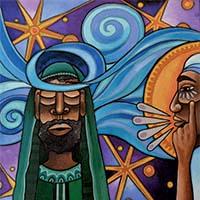
Image attribution: Pittman, Lauren Wright. Born Again, from Art in the Christian Tradition, a project of the Vanderbilt Divinity Library, Nashville, TN. https://diglib.library.vanderbilt.edu/act-imagelink.pl?RC=57087 [retrieved March 2, 2023]. Original source: Lauren Wright Pittman, http://www.lewpstudio.com/.

Friday, September 10, 2021

A reflection offered at Sacred Heart Catholic Church in Cambridge Mass, Dec, 2001


       On Monday Nov. 19, 2001, I boarded a bus in South Station for Manhattan.  I traveled with fellow deacon, Daphne Noyes.  We were responding to a call for help from deacons in New York, to serve as chaplain at the World Trade Center site.  A site known as the HellHole, the Pit, the Pile, Ground Zero.  We arrived early, met our contact person, Keith, and headed down Fulton Street to the temporary morgue that was set up just a few yards from what was left of the twin towers.

Once in the morgue we met those chaplains whom we were relieving.  One was a Rabbi and one a Catholic Priest.  We discussed the importance of offering prayers over the remains that would be appropriately ecumenical for civilian casualties.  We chose to pray with the Psalms, the 121st and the 23rd.   Then we were briefed on our duties.  We were to wait until we got a call that one of the spotters had found remains.  Then we were to go with the EMTs into the hole to pray with the laborers and fireman who were there.  We would accompany the remains to the morgue where a medical examiner would determine, if in fact, there were human remains present and whether or not the remains were that of a person of service, a fireman or policeman.  If so, the body bag would be draped with an American flag.  We were to offer prayers for the deceased and for the men and women working there and an honor guard would stand watch while the flag draped litter was carried to an ambulance to be transported to the main morgue at Bellevue Hospital.    -     I have never prayed so hard in my life.  I prayed for those who lost their lives.  I prayed for the men and women who had survived.  I prayed for those of us who felt distant and helpless in the face of such an evil act.  And I prayed for myself - that I would not shrink from the horrific sight of burned mortality, that I would have the right words to offer when we cried, that I would not get sick from the smell. 

 After a short time, Keith took us out of the morgue to walk the perimeter and to meet and talk with some of the people working on the site.  As we approached the Hole the smell of acrid, moist air grew strong.  I reached for my respirator, but hesitated wanting somehow to feel with all of my senses in order to try to grasp what had happened here.  There were piles and piles of colorless soot, twisted steel, junk.  Everywhere I looked there were huge digging machines, taking bite after bite out of the junk and placing it on the side of the hole.  Then the jaws would sift and sift to allow the spotters time to look for buried equipment, clothing, or burned flesh and bones.  There was a constant trail of smoke rising from various spots.  The pile was still burning deep within its bowels.  Each time the jaws would pull up a hot steel girder the smoke would increase, the smell would become stronger, and the water cannon would send long streams of water high into the air and flood the burning hole.  Clouds of steam would rise up like a mushroom cloud.   As we walked we saw and heard, off in the distance, a wrecking ball as it demolished piece after piece of the Customs House in one loud crash after another.  Steel and ash got loaded onto great dump trucks and flat beds that made there way out of Manhattan to Fresh Kill, the dump site that has become the resting place for the once great buildings.  Each truck was washed under overhead sprinklers before it left the site.  Everything gets washed before it leaves Ground Zero, trucks, trash, boots, and hands.

 As we walked around the site we were greeted by smiles and waves.  Men and women who were grateful for a listening ear.  Before I left Boston, I wondered what our place would be here. I know now. As men and women we have no place, but God does and we are privileged to be offered an opportunity to remind the phenomenal men and women working there that God is there with them. We offer some order and control over the process of removing the remains and for that ritual the laborers and the men of service seem to be very grateful. I rode around the site one night on a buggy with a contractor who had been in Tower 1. He escaped but a laborer that he had laid off two weeks before had gotten a job on the 110 floor. We talked for a while about being a survivor and how much that can hurt and how hard you work in the aftermath. We reminded each other of God's peace and parted. He had a really nice smile.

 Thanksgiving Day the Red Cross had neglected to schedule anyone to relieve us so we worked on – 37 hours.  I slept for a while at St. Paul’s Church.  St. Paul’s is a church that is located on the corner of Broadway and Fulton, just two blocks from the heart of what was the World Trade Center.  St. Paul’s was covered by ash and debris in the tragedy there but the structure itself was not heavily damaged.  Almost immediately after the disaster the people of St. Paul’s converted the church to a shelter for the workers at the Pile.  They have provided clothing, food, beds, medical help, and a spiritual refuge for literally thousands of men and women who entered there exhausted - physically, mentally, and spiritually.  Every inch of open space is covered with notes of thanks and encouragement from people all over the world.

Early on the morning of Thanksgiving the digging stopped as spotters had seen the bodies of two firemen and the partial remains of several civilians.  Daphne went into the Pit while I waited and prayed as each bag was brought into the morgue.  I have never felt so helpless in my life.  But I have also never felt so privileged.  Privileged to have served.  Privileged to have offered reassurance of God’s presence and love.  Privileged to have walked along the last few feet to the vehicle that would carry those heroes away.


         The great plumes of gas, steam, and debris that rise up out of the pit each time the digger hits a pocket of hot metal - set beside the sacredness of the effort that is going on there are a constant reminder of God’s presence.  Man cannot bring life back from the pit.  Only God can do that.  But what I saw there was the human expression of God’s work through the work of those men and women.  God and man are about the business of cleaning up evil's mess.  Ground Zero is holy ground and the hands of the men and women who struggle there are holy hands.  The evil that visited there wanted to create darkness, but the darkness is giving way to the light of compassion, the light of self-sacrifice, the light of love.

Sunday, April 4, 2021

Easter Vigil Sermon 2021 St Patrick's Long Beach


Tonight when we move to the Table to celebrate the Eucharist, when all of the bread and wine on that Table have been consecrated, when I reach down and pick up that Easter host and break it in half I will say:  “Behold what we are” and you will respond “May we become what we receive.”  “Behold what we are” “May we become what we receive.”

These words can be traced all the way back to St. Augustine, who, sometime in the 4th and 5th centuries, preached a sermon on the Eucharist.   In this sermon, St Augustine says: “one of the deep truths of Christian faith: through our participation in the sacraments (particularly in baptism and Eucharist), we are transformed into the Body of Christ, given for the world.” In broken bread and wine outpoured, we glimpse Christ’s broken body on the cross and see the lengths to which God is willing to go for each and everyone of us – an intimate love beyond measure. “Behold what we are: May we become what we receive.”

So that’s great for liturgy.   John over there on the piano might wonder why we are not using one of the beautiful fraction anthems on this first Eucharist of Easter.  Others might prefer that we stick with “Alleluia Christ our Passover is sacrificed for us.  Therefore let us keep the feast Alleluia.”  Just for a minute though let’s stop and think

‘What does it mean to see what we are, and to become what we receive in our lives?”   What did St Augustine mean when he said we are transformed into the Body of Christ?  Are we meant to become a broken loaf of bread and some wine? The bread goes stale, and the wine sours if left out for too long, so that doesn't make much sense.   But then again, aren’t the bread and wine more for us than what we see?

As Episcopalians we often talk about the Real Presence of Christ in the Eucharist.  After consecration, we hold that the left over bread and wine are no longer just bread and wine.  We treat them as holy, set aside for particular reverence.  When we pour out the wine, we pour it into a basin that goes directly to the ground and does not mingle with other waste water.  Unused consecrated bread is held in a place set aside, so that it is easily recognized.  Or it is buried as we would bury a body that has died.  

I am quite certain that each one of us has a slightly different understanding of what the “Real presence of Christ” means, but honestly I don’t think that is the point.   The point is that every time we receive the Eucharist, we are transformed -- or at least we should be transformed – just a little more fully into the Image of God in which we were created, so that the divine love that made us and that flows through us can become more fully expressed in the world. 

Those words at the Fraction, “Behold what we see.  May we become what we receive” ask us to look deeper at what we see- this bread and wine, the offering of Jesus, the person of Jesus, this invitation to wholeness in Jesus, and become what we see through our incorporating that wholeness and love in the world around us.  At the core of this becoming is a relationship, - a relationship with Christ - so profound that we can’t live the same anymore because of it.

This act of sharing God’s Love starts with awareness.  Awareness of the Gifts we receive at this Table and the gratitude that we have for that gift of sustenance, resiliency, consolation, and hope.  And in our gratitude we are sent on our way into the world to live differently because of what we’ve received – whether in person or virtually through the prayer for spiritual Communion -, a reception that fundamentally changes us because we now see and know ourselves differently due to the action of Christ’s birth, life, death, and resurrection. The deepest mystery is how will we act - how we are to live because of what we see and receive? 

As Christians, I believe we are called to live differently in the world, which means how we make choices in life, matters.  The needs around us are incredibly high, isolation and loneliness are our constant companions for months now.   Incomes and housing are unequal, good jobs are difficult with or without a pandemic, security seems more uncertain than it did in the past. How do we support the wholeness of God's vision for the world?

I think, we start with what’s in-front of us. When we see poverty, racism, sexism, any phobia, or any boundary that keeps us apart from one another, we ask questions about why this still happens, and we stand with those who are disposed -- because in standing with them, we are acting to support the whole.  When we start to take our grand-kids fears seriously when they tell us that climate change is the thing which keeps them awake at night, because in listening to their fears we start to act on how to work for a better world for all. When we listen and learn how to have conversations differently about mental health, removing the stigma and shame, we act to opening the door to healing and wholeness. When we begin to recognize the inequity built into a society formed on the backs of people of color and to the benefit of those who are white then we can begin to heal the wounds. 

We start, slowly, to bring wholeness to our communities through building human relationships, Christ centered relationships because, you see, this is the key, Christ came, lived, loved, and died as one of us to make us whole again -- to bring us back to wholeness through a relationship with him.  Every one of us, both here and outside this church, deserve wholeness, it's a fundamental human right. And the practice of wholeness starts right here, at this altar, today. 

“Behold what we are: May we become what we receive”

How different our lives become when we believe that every little act of faithfulness, every gesture of love, every word of forgiveness, every gift for the good of someone else, every little bit of joy and peace will multiply and multiply as long as there are people to receive it. In the Eucharistic prayer the priest takes the bread, blesses the bread, breaks the bread, and gives the bread.  That is the promise of the Eucharist: that as we know ourselves to be taken, blessed, broken, and given, we will become bread for the world. And our lives will feed and bless those around us in more ways than we can ask or imagine. Amen


Saturday, February 27, 2021

Black History Month and my knapsack of privilege: So what?

Sermon preached at St Patrick's, Long Beach; February 28, 2021

          About 10 years ago I attended a memorial service for a man who had founded a non-profit..  The man had begun a marketing firm while he was still in college and became a millionaire by the age of 29.  He was the picture of success.  He did everything right.  But one day he and his wife realized that their lives were falling apart.  They knew that something drastic had to happen or they would literally drown in their financial success.  So after careful consideration and prayer they sold everything they had, gave the money to charity, and headed off to a place in rural Georgia called Koinonia (Koi Noin ya).  It is a Greek word that refers to a shared fellowship – in particular a shared Christian fellowship. 

At Koinonia he came under the tutelage of a man by the name of Clarence Jordan.  Jordan had founded Koinonia on the principles of a life lived in community where work, worship, and worldly possessions are shared.  Jordan and his followers after him challenged the racial and economic injustice and sought a life lived in self-sacrifice – shunning the “good life” so to speak for a life dedicated to following the teachings of Jesus.  But Koinonia is perhaps best known – not for Clarence Jordan – but for the work of his student and friend whose life we celebrated.  (More info on Wikipedia)

His name was Millard Fuller and he spent most of his life finding ways to provide shelter for the most disenfranchised people.  They built modest houses on a no-profit, no-interest basis, making homes affordable to families with low incomes. Homeowner families were expected to invest their own labor into the building of their home and the houses of other families. This reduced the cost of the house, increased the pride of ownership and fostered the development of positive relationships. Money for building was placed into a revolving fund, enabling the building of even more homes.  In 1974 Habitat for Humanity International was founded and I suspect you know the rest of the story.

Tuck that story away in your heart for a minute and let’s look at this reading from Mark’s Gospel.  Mark is the earliest Gospel and one that was written to a community that was living under tremendous persecution from both Roman and Jewish authorities.  They would have understood suffering in a way that few of us do.  As these stories in Mark unfolded it became increasingly clear that the disciple’s idea of “messiah” was not what Jesus had in mind.  And so, today, Jesus tells them that in order for God’s Kingdom to come about it is inevitable that he will be rejected by his people, suffer great torture, be murdered.  Before Jesus could get to the part about the “third day” the disciples had stopped listening.  They were horrified -Peter most of all.  And so Peter pulls him aside and Mark says “rebukes him”  Jesus’ response is swift and sure.  He calls Peter Satan and tells him to get out of his way. 

As I read this, I kept going back to last week where Jesus was tempted by Satan in the wilderness and cared for by angels.    Satan, we are told in other Gospels, offered Jesus’ wealth, power, and might if he would deny his love for God.  Jesus’ rebukes Peter, because Peter is challenging his vocation – tempting him with doubt.  But Jesus knows that the hand-writing is on the wall.  He cannot, in good conscience, stop himself from teaching and preaching about helping the poor, visiting the sick, reaching out to the outcasts in society. 

Jesus knows that unless he speaks out they will have no advocate to stand with them in the face of Roman tyranny and religious persecution.  The peace and comfort of God’s Kingdom will not come about unless he takes a stand and yet if he takes a stand he will most assuredly be tortured and killed.   That’s the human side of the dilemma.     But Jesus also knows that somewhere somehow God will not allow hatred and malice to overcome the Love of God.  Jesus is absolutely committed to serve God by offering himself fully as servant and no amount of suffering will interfere. 

And then Jesus turns to the other disciples, to the gathered crowd, and yes to us and says that we too have a decision to make.  We too have a line to draw in the sand.  We too, if we desire to be disciples - followers of Jesus - will have to make a decision between the comforts of our human life and the discomfort of standing with those who are neglected, marginalized.  We too will have to make a decision whether to hide our light under a bushel or stick it out there in the wind for all to see knowing that someday – someone is likely to bite that finger off. 

February is Black History month.  This year I have heard more stories about the contributions of people of color to our world than at any other time.  And yet there is hanging over us all the reality of systemic racism, the travesty of white privilege, and the danger of terrorists who would destroy our country in order to promote white supremacy.   Truth be told we can say the same thing about homophobia or misogyny, or isolationism.   It seems to me that this Lent we are those disciples who are faced with the decision to discard the values that have supported us all of their lives and take up the responsibility to stand with and to support those who are marginalized, to honor and respect all of creation.  In the down and dirty – what do you say at the grocery store when someone makes a racist statement, or refuses service to someone who is gay, or passes over a candidate for promotion because she is a woman.  When faced with income, education, or housing disparity... do we turn away or do we speak up at the ballot box and on the street corner?  Do we – living here in Mississippi with a tragic history of slavery, racism, and oppression weighing us down like a ball and chain - speak out openly and clearly to reject the racist rhetoric or do we smile uncomfortably, say nothing, and play like the guy next door didn’t really mean the threats and name-calling.      

It is hard to hear these words of Jesus about carrying crosses, denying ourselves, giving up our life – hard to hear them and frightening to the core.  We are taught from birth that avoiding conflict, protecting our self-image, looking past the panhandler on the street, locking our doors, keeping order, these are the things that will make us safe, happy and content.  And the opposite – challenging the injustice of our culture, risking our safety to open the door to the stranger, sacrificing our own comfort and peace so that others may come in from the cold, these things are not what our society tells us will bring us happiness.    And yet those are exactly the things that Jesus says will bring us life.

This morning I am asking you to just consider what if – Jesus is exactly right and the way of the world is exactly wrong.   What if letting go of whatever it is that prevents you from listening to that still small voice in your heart that is calling you to answer Jesus’ call to discipleship is exactly the thing that will open you to a new life in Christ.  I don’t know what it is that Jesus has for you to do – but you know.  I don’t know who Jesus is calling you to love – but you do.  I don’t know who Jesus is asking you to talk to about God’s love – but you do.  I don’t know who needs you to pray with them – but you do.  You do because when you ask him, Jesus will show you the way.  When you pray God will answer with the assurance of love.

One of the things that I really miss in the contemporary liturgies are the “Comfortable words”...  “Hear the word of God to all who truly turn to him – Take my yoke upon you and learn from me, for my yoke is easy and my burden is light and you will find rest for your souls”.  That is the enigma here.  That is the mystery of discipleship.  Taking on the cross brings rest for our souls.  Millard Fuller knew it.  And the world is a better place for his having lived.  The question for us this Lent is what cross do we need to take up in order to make the world a better place for us having lived?

Thursday, October 8, 2020

The Lord is my Shepherd


The Psalm this week is Psalm 23.  The last time we heard this psalm was Easter 4, Good Shepherd Sunday.  It, like Isaiah 25, is often read at funerals because it offers comfort and reassurance to a people who are hurting and filled with anxiety and uncertainty. 

Often though when a text is familiar to the bone, I find that the message I hear in the text can change according to the situation in which I find myself.  Psalm 23 read on Good Shepherd Sunday might call up images of Jesus carrying a lamb on his shoulders.  I have one of those images on a small icon with the admonition from my bishop to “Feed my sheep”.   Psalm 23 read at a funeral might bring comfort as “the valley of the shadow of death” leaps to center stage.  And perhaps this coming Sunday, in the context of Jesus’ parable of the wedding banquet, I might look for reassurance in the table prepared in the presence of my enemies.

This week in your prayer time think back to that Sunday in May as we fasted from Eucharist and wondered when life would return to “normal”.  Perhaps you might go to the website and listen to Pastor Barb’s sermon to jog your memory.  Then take some time in prayer to see how Psalm 23 speaks to you today. 

There is a collect in the Order for Compline that invites us who are “wearied by the changes and chances of this life” to find rest in “God’s “eternal changelessness”.  Hurricanes, Covid, elections….  grief, exhaustion, fear, all of these are passing moments.  God’s love and compassion endures.  See you in church on Sunday.

Buen Camino,

Mother Jane


Sunday, September 6, 2020

Labor Day Sermon

A Homily on Conflict.
Preached at St Patrick's Episcopal Church in Long Beach Mississippi
September 6, 2020


Click here for homily.

Matthew 18:15-20
Jesus said, “If another member of the church sins against you, go and point out the fault when the two of you are alone. If the member listens to you, you have regained that one. But if you are not listened to, take one or two others along with you, so that every word may be confirmed by the evidence of two or three witnesses. If the member refuses to listen to them, tell it to the church; and if the offender refuses to listen even to the church, let such a one be to you as a Gentile and a tax collector. Truly I tell you, whatever you bind on earth will be bound in heaven, and whatever you loose on earth will be loosed in heaven. Again, truly I tell you, if two of you agree on earth about anything you ask, it will be done for you by my Father in heaven. For where two or three are gathered in my name, I am there among them.”

Acension Sunday - Remembering Joy and Looking the Wrong Way

  I’m going to go out on a limb here and suggest that for much of our Christian understanding and belief - the Resurrection is the culminati...